The Birth of Contexturalism: Not Monet's Sunflowers

As I explained in my inaugural blog post, I had chosen to use acrylic paints because I hoped to thin them to the consistency of ink and use them to create paintings using the same patterned style I had used in my ink drawings. Now that I was feeling comfortable with acrylics, I decided to give my style a try.

I stumbled upon a photo of Monet's painting Bouquet of Sunflowers. I was intrigued by the painting partly because when I first saw it, I thought it was by Van Gogh. The colors and textures in the painting seemed ideally suited to my style, so I decided to create my own interpretation of it.


WebMonetSunflowers.jpg

My first thought was to name it Not Van Gogh's Sunflowers to poke fun at my initial confusion. However in deference to Monet and to make sure that no one confused my painting with his original (ha!), I decided a more appropriate name was Not Monet's Sunflowers.

 I started by painting the patterned sunflowers and leaves. 

WebMonetSunflowersDetail2.jpg


When I painted the patterned background behind the sunflowers, I thought there needed to be a better blending of the colors. I tried adding a layer of dots of various colors onto the patterns to help blend them, and I really liked the resulting effect. It added an interesting texture to the background while smoothing out the colors and helping the sunflowers pop. 


Not only were acrylics allowing me to create colors that ink did not, they also were allowing me to use multiple layers of colors. This combination of varying colors for the base layer, the patterns on the base layer, and finally the dots on top of the patterns is what creates the textures that are the heart of contexturalism. 

To highlight the textures of the sunflowers and background, I painted the vase and tablecloth without patterns and dots.


Thus the painting Not Monet's Sunflowers was finished and contexturalism was born! 

It was not a Monet, but I was pleased with it. It confirmed that acrylics were the perfect medium for my contextural paintings.


My Inaugural Post

I started drawing in junior high school. For many years, I used ink on paper to create and combine small, individual patterns into larger elaborate abstract drawings.  The best example of one of these ink drawings is Ginseng Man shown below.   


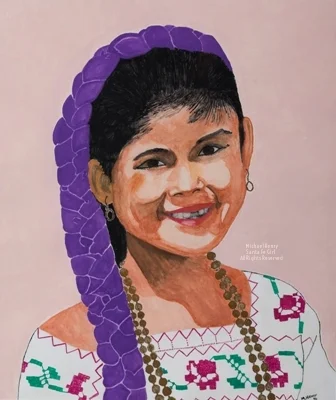
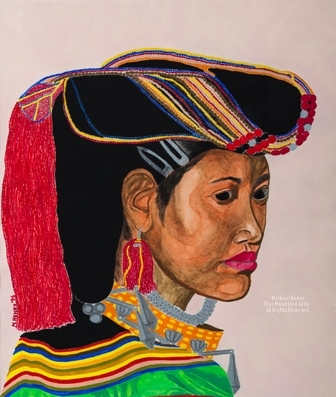
In the early 1990's, I started to play with watercolor for the first time. After years of using ink for very precise drawings, watercolor seemed almost impossible to control. I experimented with using less and less water to make the watercolor more controllable. I found that if I used very little water with the watercolor on completely dry paper that I felt more in control.  Of course I was totally ignorant about all of the wonderful effects that good watercolor painters can create, but I went blindly ahead with my 'dry' approach. I quickly learned that it worked best to start with the lightest colors and then add darker colors on top of the lighter colors when needed.  I felt comfortable enough with my 'dry' watercolor technique to try to paint some portraits.

My first attempt wasaportrait of a Masai woman we had met on the side of the road in Kenya.  She was asking for money to buy school supplies for her children. One of the women in our mini-bus was a pen seller and had brought pens along on the trip to hand out to children.  She handed this woman some of these pens instead of money. The woman didn't know exactly how to react. She was indeed getting school supplies for her children but wasn't getting the money she was expecting.  We captured her somewhat stunned look in a photo that I was using for this portrait.

I started by doing a pencil sketch of the portrait. I then added the lightest flesh tone over the entire face, exposed shoulders and hand. I then added darker flesh tones and was mesmerized as her face started to develop before my eyes much like an old Polaroid photograph. I finished the painting by adding on the colors of her garments,  jewelry and of course the pen.  I was pleasantly surprised by the final painting shown below.


Given the success of my first watercolor portrait, I used this same 'dry' watercolor technique to paint some more portraits of-

a Santa Fe Girl


a Mountain Lady in Thailand


and my brother Stan


I showed these watercolor portraits to an artist friend and discussed the difficulty I had with controlling watercolors until I took most of the water out of them. I also discussed how I liked the control I had with ink, but really wished I could get the vast array of colors available in watercolor in inks. The friend asked me if I had ever tried using acrylic paints because I could thin the acrylic paint to the texture of ink and would have unlimited colors available. This conversation was an epiphany to me. I knew nothing about acrylic paints, but they sounded like they were perfect for me. I couldn't wait to try them. 

My first attempt with acrylics was a small painting of a peony shown below. Indeed the acrylics could be thinned to whatever consistency I wanted and the colors could be mixed to create any color I needed. I had found my medium of choice. 


Another early acrylic painting was an iris.


A more challenging acrylic painting was a still life of apples in a bowl.  It turned out pretty well, especially the granny smith apple. However the highlight of the painting was the lace tablecloth with its intricate detail.


My next blog will discuss the beginnings of contexturalism.